Summary
Most investors focus on understanding and valuing a business by modelling demand-side economics. This approach is rife with assumptions and predictions that consistently produce unsatisfactory results across the asset-management industry. The Capital Returns methodology flips the script by assessing the supply-side flows of capital into an industry, allowing the analyst to find businesses that have strong economic prospects ahead of them without reliance on models that overemphasize the need to predict the future. By focusing on what is sure — the here and now — Capital Returns promises a simpler process and better returns for investors.
Takeaways
The Asset Growth Anomaly
It seems obvious to most investors that big capital investments lead to big future returns. A company pours money into new infrastructure, expands capacity, builds out operations, and eventually all that capital expenditure gets “turned on”, leading to growth. The market prices this in and the stock reflects that optimism. However, as pointed out by Marathon Asset Management, this expectation is incorrect and not only leads to investment underperformance, but hints towards a fundamental misunderstanding investors hold in their minds when it comes to business analysis.
Referencing a paper in the Journal of Finance, a phenomenon called the asset-growth anomaly showed how across a wide range of companies, asset expansion activities were frequently followed by poor future returns. Equity and debt financing, used to fund acquisitions or infrastructure build outs, consistently fail to produce the results investors expect.
What’s more striking, is that the reverse was equally true. Asset contraction activities such as share buybacks, debt repayment, spin-offs, and dividend initiation tend to precede periods of outperformance.
The implication is uncomfortable. When a business is aggressively deploying capital, something is usually wrong. Not with the business. Obviously reinvestment is important to growth. But with the industry around it, as an opportunity for shareholder ROI.
Capital is flooding into the industry because demand looks strong and returns look attractive. But it is precisely this flood of capital that will erode those returns. By the time the investment thesis is obviously enough to justify spending, that opportunity is already starting to crowd out and competition eats up the results.
It’s hard not to see parallels for this exact process happening with the AI industry today. The hyperscalers - Meta, Amazon, Microsoft, Google, etc. - have all committed extraordinary amounts of capital to AI data centre build-out. Some of them have seen large run ups in price. Others have dropped off to their lowest valuations in years. The market seems to be grappling with whether those investments will generate commensurate returns. But the asset-growth anomaly would suggest that investors should be cautious, especially when CEOs of these companies are actually saying that an over-build is likely.
So why does this keep happening? Why do investors keep misreading large capital expenditures as a bullish signal? The answer, according to Marathon Asset Management’s Capital Returns, is that investors are looking at the wrong side of the equation entirely.
The Problem With Traditional Methods
The standard approach for analyzing a business starts with demand. How large is the market? How fast is it growing? What share can this company capture? Analysts build detailed revenue models, project growth rates out five or ten years, and discount the resulting cash flows back to a present value.
The problem, according to Marathon, is that this process, however carefully executed, is built on a shaky foundation. Demand is inherently really hard to forecast. It depends on several genuinely uncertain and unknowable factors, like consumer behaviour, macroeconomic conditions, competitive dynamics, and technology shifts. Models built using this method produce clean, precise-looking outputs, but built on deeply imprecise inputs.
Supply by contrast, is observable in the present. You can see how many competitors are in a market. You can see whether new capacity is being built or whether investment is retreating. You can watch capital flow in and out of an industry in real time, without needing to predict what consumers will do five years from now.
This is the core of Marathon’s framework: the capital cycle.
The Capital Cycle
The Marathon capital cycle works as follows.
- A business finds success through great product and limited competition, producing strong returns.
- That success attracts capital. Competitors enter the market, investment floods in, supply expands. The offering becomes commoditised, margins compress, returns deteriorate. What looked like a great industry becomes a crowded one.
- The cycle turns. Poor returns drive capital out. Competitors exit or collapse. The firms that remain find themselves in a pseudo-oligopoly, able to exercise pricing discipline and compete on quality rather than racing each other to the margin floor. Returns recover and the best risk-adjusted opportunity arrives.
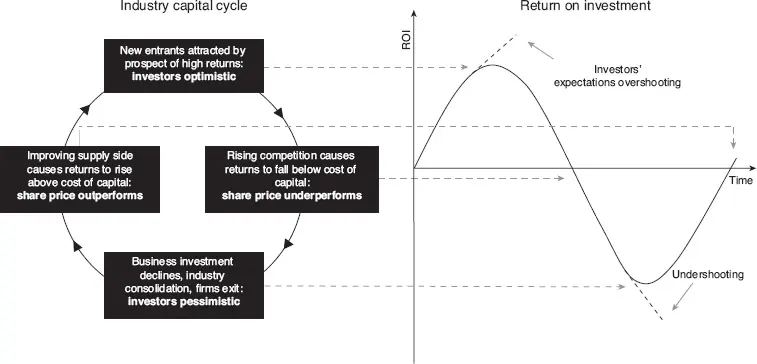
Strong demand growth, Marathon argues, is often the direct cause of value destruction. It attracts too much capital, and that capital destroys the returns that attracted it in the first place.
How To Use The Capital Cycle
Signs The Capital Cycle Is Turning
Understanding the capital cycle is one thing. Knowing when to act on it is another. Marathon points to two practical signals they use as a trigger warranting further inspection.
The first is a competitor exiting the market. When a firm is unable to secure capital through a demand downturn and is forced to throw in the towel, it is a meaningful sign that broad market pessimism is present. But because of how pessimism spreads in markets, when one business fails, the market often punishes the survivors alongside it, even if those survivors are well-capitalised and well-positioned. For an investor willing to take a multi-year view, this pessimism creates the entry point for the highest quality businesses in the industry.
The second signal is the changing ratios of capital expenditure to depreciation. When cap. ex. begins to fall relative to depreciation, it signals the industry’s build-out phase is ending. Firms are no longer racing to add supply and are beginning to harvest the infrastructure already built. Free cash flow, previously consumed by investment, becomes available to shareholders. When the ratio moves in the opposite direction, cap. ex. rising relative to depreciation, it signals the reverse: cash flows being diverted away from shareholders to fund competitive positioning.
Capital Cycle Purchase Candidates
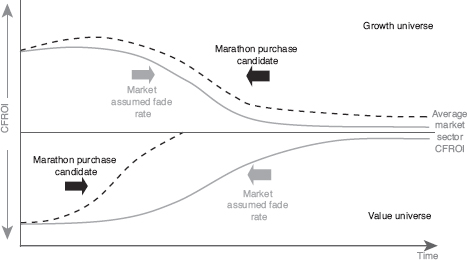
Once you have identified an industry where the capital cycle is functioning and the timing looks right, the question is which businesses to buy. Marathon divides candidates into two groups.
Growth candidates are businesses where the market is dramatically underestimating the terminal size of the opportunity. These are not necessarily dominant players, they may not even be profitable yet, but the addressable market is far larger than current investor assumptions reflect.
The early years of Uber is a good example. Investors valued it as a taxi company, pricing its terminal value against the taxi industry’s total revenue. What they missed was that the app and gig economy unlocked a TAM far beyond taxis: more rides, food delivery, package delivery, and eventually travel. The market was thinking small about something that was growing large.
Value candidates are businesses where the market is underestimating the barriers to entry, and therefore assuming that competitive pressure will erode margins faster than it actually will.
Booking Holdings might prove a contemporary example, in my opinion. The surface-level narrative is that AI will make it trivially easy to find hotels directly, rendering Booking’s marketplace irrelevant. What that narrative misses is the depth of Booking’s integrations with independent hotels across Europe. They have spent years building system integrations for real-time room availability, dynamic pricing, photography, and localized content that is not something an LLM reading a hotel’s website can replicate. Network effects from years of accumulated reviews compound the moat further.
How To Think About Price and Value
While the capital cycle tells you where to look and when to move, it does not stray from the fundamentals of investing with it comes to thinking carefully about price. That means questioning some of the most widely used metrics in investing.
Short-comings Of The P/E Ratio
The price-to-earnings ratio is the default valuation metric for most investors and analysts. It is also, in many cases, the wrong one to anchor to.
Earnings are an accounting construct. As a CPA and former auditor, I can speak with some candour here: not all earnings are equal. A business generating $10 of earnings while consuming $9 in maintenance capital expenditure is a very different situation from one that converts those same earnings cleanly into free cash flow.
Airlines are the textbook example: impressive earnings figures that routinely disappear into aircraft maintenance, fleet replacement, and infrastructure costs. The investor in airlines is perpetually reinvesting just to stand still. The income statement does not always capture this cleanly.
When it comes to earnings quality, for a high-level metric, the better choices are price to operating cash flow or price to free cash flow. These strip away accounting noise and capture what the business is actually able to return to its owners.
High Valuations ≠ Overpriced
One of the lessons learned the hard way by Marathon is that a high valuation is not, by itself, a reason to avoid a business.
Consider two businesses, each earning $1,000 today. Business A trades at 10x earnings — $10,000. Business B trades at 20x — $20,000. On a P/E basis, Business A looks cheaper. But if Business A grows earnings at 5% per year and Business B grows at 30%, the picture shifts quickly.
| Business A | Business B | |||||||
|---|---|---|---|---|---|---|---|---|
| Year | A Earnings | A Price | A P/E | A Growth | B Earnings | B Price | B P/E | B Growth |
| 1 | $1,000 | $10,000 | 10x | 5% | $1,000 | $20,000 | 20x | 30% |
| 2 | $1,050 | $10,000 | 9.5x | 5% | $1,300 | $20,000 | 15.4x | 30% |
| 3 | $1,103 | $10,000 | 9x | 5% | $1,690 | $20,000 | 11.8x | 30% |
| 4 | $1,158 | $10,000 | 8.6x | 5% | $2,197 | $20,000 | 9.1x | 30% |
| 5 | $1,216 | $10,000 | 8.2x | — | $2,856 | $20,000 | 7.0x | — |
By year four, Business A is earning roughly $1,158 — a P/E of about 8.6x at its original price. Business B is earning roughly $2,197 — a P/E of just over 9x at its original price. The businesses are now valued similarly. But Business B, still growing, almost certainly has more runway, stronger competitive position, and better long-term economics. The investor who bought it in year one at 20x paid what looked like a premium for something that turned out to have been cheap.
The framework does not change: you still cannot overpay. A high multiple paid for growth that never arrives is simply a bad investment. But a disciplined value investor who relies exclusively on low earnings multiples as a filter for “value” should not be surprised to find that many businesses they passed on went on to significantly outperform the ones they bought.
Great businesses deserve high valuations. The investor’s job is to understand whether the valuation is warranted.
Where the Capital Cycle Fails
Marathon is also intellectually honest about where the capital cycle framework fails to function as described. In the book, they provide three clear cut cases.
1. Product Complexity
Car manufacturing has consolidated significantly, with oligopolistic dynamics in many segments. Yet shareholders have consistently been disappointed. The reason is that a winning car depends on an accumulation of decisions across dozens of value-chain components: feature specification, financing terms, safety regulation compliance, launch marketing, service and warranty execution. The results that the capital returns methodology predicts, however, depend on a “tit-for-tat” industry dynamic, where industry players can clearly see what other competitors are doing. In the paper industry, for example, there is little a manufacturer can do to differentiate their offer. Therefore, market competition is typically driven by price fluctuations. It’s easy for the whole market to raise or lower the price of the product to match each other because it is clear what is happening. With cars, however, a manufacturer can effectively lower the price of the vehicle without changing the sticker price. They can change financing terms, or fuel efficiency, etc. This makes changes in the real price of the product opaque and much more difficult for management teams across the industry to follow and maintain consistency in the industry through prices and therefore margin.
2. Political Interference
The capital cycle depends on free, uninterrupted market processes. Under-performers must be forced to exit, capital forced reallocate, and industries forced to undergo severe but natural resets. When a government has a stake, real or implied, in the ongoing success of a business, this mechanism is disrupted. European national airline champions are a clear example: rather than restructure when capacity is oversupplied, these businesses pursue market share-capture strategies, spending more money to sustain inefficient operations. Inefficiency becomes permanent, and the opportunity never arrives.
3. Exceptional Management
Bunzl, the British distribution business, is Marathon’s own example. Its management team has an unusual ability to identify and integrate bolt-on acquisitions in a consistently value-accretive way. Conventional analyst models forecast cash flows based on existing operations and miss the opportunity because the acquisitions are both continuous and accretive, and doesn’t show up in backward-looking data. When a management team genuinely has differentiated capital allocation skill, the market tends to underprice them for longer than you might expect.
Personal Opinion
As an analyst, it stings a bit to admit that I see Marathon’s point when they say that financial models are fraught with errors. Huge data sets, carefully linked assumptions, scenario toggles do often produce outputs that carry an aura of assurance undeserved by the genuine uncertainty that they contain.
And yet, I don’t that there isn’t value in them. Whether I’m managing my own money, or providing a recommendation on a business decision at work, I would not feel comfortable abandoning the rigorous thought and consideration that goes into building a model. To adapt Eistein’s famous quote - A model should be as simple as possible, but no simpler. It’s not that the output of a model is precise, its that the process of building one forces the analyst and the team to ask concrete questions about growth rates, margins of safety, and other assumptions we may make without consideration if we are not forced to input them into a model.
That said, I also have a background in economics and I find Marathon’s supply-side logic of the capital cycle genuinely compelling. I think it makes perfect sense under the conditions they laid out, and agree on where it can fail. I think it belongs as a keystone component in business analysis I do going forward. The Marathon framework can guide where to look, where to avoid, and give conviction on whether a genuine opportunity may exist. Then the valuation modelling tells you what an opportunity is worth and how much to pay. The capital returns framework, in my opinion, is not viable enough to stand on its own, but it is powerful tool for any analyst with coupled with traditional methodology.
Notes
Detailed Forecasting Adds Little Value
Signs of The Capital Cycle Turning