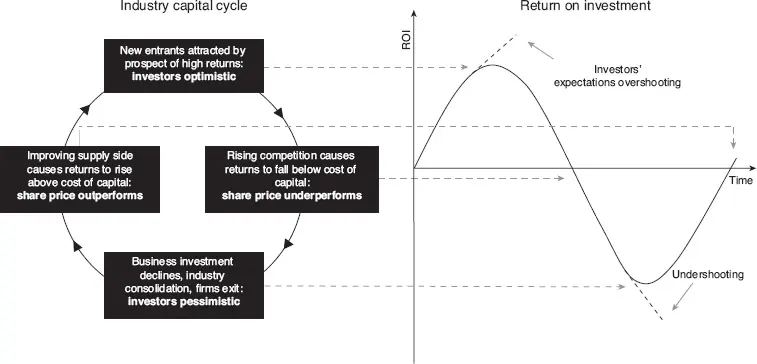
The capital returns cycle, developed by Marathon Management Partners, is an investing framework that focuses on identifying opportunities through the analysis of supply-side dynamics. Many times when assessing a business, investors focus on the opportunity by trying to estimate and predict demand for the products or services that business provides. This is inherently difficult and complicated. Marathon argues that understanding the supply-side dynamics of the industry is easier and thus more likely to lead to success.
The cycle works as follows:
- A business sees success by providing the market with a great product or service and limited competition. This produces high shareholder returns.
- The success of that business causes a flood of capital into the industry via competitors, as investors try to get a piece of the strong returns.
- The increase in competition leads to the commoditization of the offering, and/or reduced margins for all participating firms, leading to underperformance in terms of investor returns.
- Poor results leads to outflows of capital from the industry, allowing those businesses that remain active to capture more of the market and produce strong returns.
When this happens, in the period following capital retreat, a pseudo-oligopoly can form between a few key players who can exercise pricing discipline and compete on offerings rather than a race to the bottom which only erodes margin.
The primary driver of healthy corporate profitability is a favourable supply side — not high rates of demand growth. Hence, it is possible for there to be rapid growth in an industry which brings little or no benefit to investors. In fact, strong growth in demand is often the direct cause of value destruction as it encourages a flood of capital into the industry, eroding returns.
Connections
In Risky Markets, Leaders Provide The Best Risk-Adjusted Returns
Link Explanation: The linked note discusses how established industry players provide the best risk-adjusted returns because they have the scale and stability of operations to withstand periods of intense competition. This is directly related to the capital cycle as those businesses are the ones that remain after peak capital inflows and competition, thus providing the best outcomes in the periods post capital retreat.
Link Explanation: The capital cycle is essentially a tool for exercising second level thinking. By referencing the capital cycle, an investor can think beyond the narrative and hype to understand whether competition is increases or decreasing in an industry and thus whether returns on the investment are more or less likely.
Act On The Present, Not Forecasted Futures
Link Explanation: The capital cycle is a methodology that is inherently useful for investors with a preference to act on the present, rather than try to predict the future. Forecasting demand in a DCF model is a process rife with assumptions and errors. Simultaneously, assess the current industrial landscape for whether capital and competition is retreating is a decision one can make on present information and thus have more assurity that one is directionally correct.