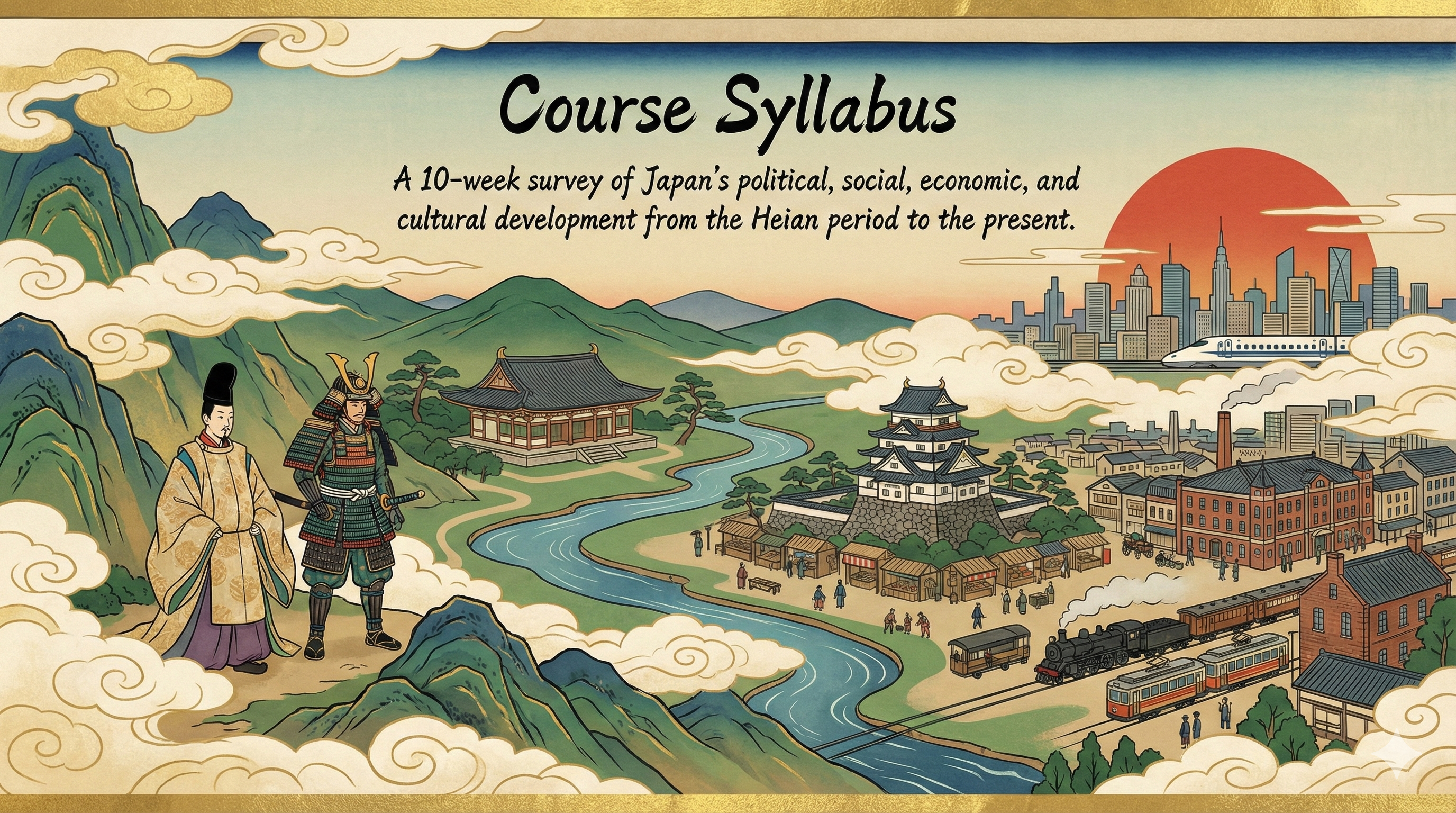
Course Description
A 10-week survey of Japan’s political, social, economic, and cultural development from the Heian period to the present. Themes will include the foundation of the early aristocratic state, warrior regimes, the rise of the Japanese empire in the 19th and 20th centuries, and Japan’s recovery and economic development after World War II.
Required Texts
- Hane & Perez, Premodern Japan: A Historical Survey (2nd ed.)
- Gordon, A Modern History of Japan (4th ed.)
- The Diary of Lady Murasaki (Bowring translation)
- Huffman, Modern Japan: A History in Documents (2nd ed.)
Assignments (3 total, 30-60 minutes each)
Assignment 1: Heian Kyoto Spotter’s Guide (Due Week 2)
After reading about Heian and Samurai culture and Murasaki’s diary, create a one-page visual/text guide identifying 5-7 specific things you’ll look for at historical sites that reflect aesthetics and beliefs of the time.
Examples: Architectural features (curved roofs, vermillion gates), Buddhist imagery, gardens designed for “borrowed scenery,” seasonal references, moon-viewing platforms.
Format: Can be a simple document with images/sketches, a Pinterest board, or an annotated Google Map. The goal is a practical reference you’ll actually use.
Assignment 2: Three Cities, Three Characters (Due Week 4)
After learning about the Tokugawa period, write 3 short paragraphs (400-600 words each) explaining the distinct historical character of each city:
- Kyoto: The old capital - what remains from its imperial/aristocratic past?
- Tokyo/Edo: The new power center - how Tokugawa rule shaped it?
- Osaka: The merchant capital - why it became “Japan’s kitchen”?
Include 2-3 specific sites or districts in each city that exemplify its character.
Purpose: Frame your trip around understanding these three different historical identities.
Assignment 3: Your Personal “Must-See” List (Due Week 10)
Now that you understand the full historical arc, create a curated list of 10-15 sites across the cities you’ll visit that you’re most interested in seeing, organized by historical period.
For each site, write one sentence explaining what historical moment or theme it represents and why you want to see it.
Example: “Yasukuni Shrine (Tokyo) - Meiji-era war memorial that remains controversial; want to understand how Japan grapples with its imperial past.”
Purpose: Transform abstract history into concrete places you’ll experience. This becomes your actual trip itinerary.
Local Field Trips (Vancouver, BC)
To ground the abstract history of the “Golden Route” in tangible experiences, you will complete three site visits. These are timed to provide local context to the political and social shifts you are studying in the texts.
Field Trip 1: The Heian Aesthetic & Garden Philosophy
Location: Nitobe Memorial Garden (UBC) | Hours of Operation
Timing: Week 1 (The Heian Era)
Objective: Though the Nitobe Memorial Garden is not based on Heian aesthetics, visiting the garden provide a great opportunity to familiarize yourself with core Japanese aesthetic principles (borrowed scenery, seasonal awareness, controlled revelation of space) and begin to feel the vibe that the traditions bring.
Pre-Read: “Japanese Gardens Reveal a Philosophy Opposite to Western Ones” by Satomi Takayama
Key Question: How does the garden’s layout reflect the Heian-era preoccupation with the transience of life (mono no aware)?
Field Trip 2: Meiji Migration & Industrialization
Location: Steveston Village (Murakami House & Britannia Shipyards)
Timing: Week 6 (Building the Modern Nation)
Objective: Connect the high-level Meiji reforms in Gordon Chapters 6-8 to the actual lives of the people who left Japan during this upheaval.
Pre-read: “A Capture of Memories: The Murakami Family at Britannia”
Key Question: Based on your readings, what specific economic pressures in Meiji Japan would drive a family to move from a rural prefecture to a fishing village in BC?
Field Trip 3: The Diaspora & The “Dark Valley”
Location: Nikkei National Museum & Cultural Centre (Burnaby)
Timing: Week 7 (The Dark Valley)
Objective: Analyze the global consequences of Japanese militarism. Contrast the “official” nationalism you are reading about in Huffman with the lived experience of the Japanese-Canadian community during the Pacific War.
Pre-read: “Explorations - Japanese Canadians” (1960 CBC Documentary).
Key Question: How did the “Imperial” identity discussed in Gordon Chapter 11 conflict with the reality of being a Japanese person living abroad during the 1940s?
Weekly Schedule
Week 1 - The Heian World: Kyoto’s Golden Age
Readings & Deliverables:
- Hane & Perez, Chapter 3 (The Heian Period)
- The Diary of Lady Murasaki (entire book)
- Field Trip Pre-Read: “Japanese Gardens Reveal a Philosophy Opposite to Western Ones” by Satomi Takayama
- Field Trip to Nitobe Memorial Garden
Focus:
- Why Kyoto became the capital
- Aristocratic Buddhism and court culture
- The aesthetic world that defined classical Japan
Trip Key:
-
Imperial Palace (Kyoto)
-
Fushimi Inari
-
Kiyomizu-dera
-
Understanding Heian-era temples and shrines
-
[9] 🚌 Field Trip: Nitobe Memorial Garden (UBC)
Week 2 - Warriors Take Power: Kamakura to Civil War
Readings & Deliverables:
- Hane & Perez, Chapter 4 (Kamakura Period)
- Hane & Perez, Chapter 5 (Ashikaga Period)
Focus:
- Military rule replaces aristocratic rule
- Zen Buddhism and samurai culture
- Century of civil war and why Japan needed unification
Trip Key:
-
Kinkaku-ji (Golden Pavilion)
-
Ginkaku-ji (Silver Pavilion)
-
Understanding warrior culture’s influence
-
[8] 📝 Assignment 1 due this week: “Kyoto Field Notes”
Week 3 - The Great Peace: Early Tokugawa Japan
Readings & Deliverables:
- Hane & Perez, Chapter 6 (Restoration of Order)
- Hane & Perez, Chapter 7(Tokugawa Polity)
- Quizzes
Focus:
- 250 years of peace and isolation
- Edo (Tokyo) becomes the real capital
- Castle culture and urban development
Trip Key:
- Osaka Castle
- Nijo Castle (Kyoto)
- Understanding why Tokyo exists and how it overtook Kyoto
Week 4 - The Great Peace: Late Tokugawa Culture & Economy
Readings & Deliverables:
- Hane & Perez, Chapter 8 (Intellectual/Cultural Developments )
- Hane & Perez, Chapter 9 (Late Tokugawa Period))
- Huffman, Chapter 1 (The Shogun’s Realm)
- Assignment 2
Focus:
- Merchant culture and Osaka as “kitchen of Japan”
- Ukiyo-e, kabuki, geisha districts
- Seeds of modernization while isolated
Trip Key:
-
Dotonbori (Osaka)
-
Geisha districts (Kyoto)
-
Understanding Edo-period art and popular culture
-
[8] 📝 Assignment 2 due this week: “Three Cities, Three Characters”
Week 5 - Revolution: The Meiji Transformation
Readings & Deliverables:
- Gordon, Chapter 4 ( Overthrow of Tokugawa )
- Gordon, Chapter 5 (Samurai Revolution)
- Huffman, Chapter 2 (The Old Order Topples)
Focus:
- Why Japan modernized when others couldn’t
- Deliberate cultural revolution from the top
- Emperor worship and nationalism
Trip Key:
- Meiji Shrine (Tokyo)
- Understanding modern Tokyo’s origins
- Why Japan looks “Western” but isn’t
Week 6 - Building the Modern Nation (1870s-1900s)
Readings & Deliverables:
- Gordon, Chapters 6 (Participation and Protest)
- Gordon, Chapters 7 (Social, Economic, and Cultural Transformations)
- Gordon, Chapters 8 (Empire and Domestic Order)
- Huffman, Chapter 3 (Confronting The Modern World)
- Huffman, Chapter 4 (Turning Outward)
- Field Trip Pre-Read: “A Capture of Memories: The Murakami Family at Britannia”
Focus:
- Industrial revolution and social transformation
- Education system and cultural modernization
- Japan becomes an imperial power
Trip Key:
-
Tokyo Station
-
Yasukuni Shrine
-
Understanding Japanese nationalism and empire
-
[9] 🚌 Field Trip: Steveston Village (Murakami House & Britannia Shipyards)
Week 7 - The Dark Valley: From Democracy to Disaster (1920s-1945)
Readings & Deliverables:
- Gordon, Chapters 10 (Democracy and Empire between the World Wars)
- Gordon, Chapters 11 (The Depression Crisis and Responses)
- Gordon, Chapters 12 (Japan in Wartime)
- Huffman, Chapter 5 (Imperial Democracy)
- Huffman, Chapter 6 (The Dark Era)
- Field Trip Pre-Read: “Explorations - Japanese Canadians” (1960 CBC Documentary).
Focus:
- Brief democratic moment crushed by militarism
- China war escalates to Pacific War
- Devastation and defeat
Trip Key:
-
Why WWII still matters everywhere in Japan
-
Understanding Japan’s complex relationship with neighbors
-
Peace memorials and constitutional pacifism
-
[9] 🚌 Field Trip: Nikkei National Museum & Cultural Centre (Burnaby)
Week 8 - Rebirth: Occupation and Economic Miracle (1945-1970s)
Readings & Deliverables:
- Gordon, Chapter 13 (Occupied Japan: New Departures and Durable Structures)
- Gordon, Chapter 14 (Economic & Social Transformations)
- Huffman, Chapter 7 (The Reemergence)
Focus:
- American occupation and constitutional revolution
- From devastation to world’s second-largest economy
- New social contract and “salary man” culture
Trip Key:
- Understanding post-war Japan’s character
- US military presence
- Economic success and its social costs
Week 9 - Bubble and Stagnation: Japan’s Recent Decades (1980s-2000s)
Readings & Deliverables:
- Gordon, Chapter 15 (Political Struggles and Settlements of the High-Growth Era)
- Gordon, Chapter 16 (Global Power in a Polarized World: Japan in the 1980s)
- Gordon, Chapter 17 (Beyond the Postwar Era)
- Huffman, Chapter 8 (Japan As A World Power)
Focus:
- 1980s boom and “Japan as Number One”
- 1990s crash and “Lost Decades”
- Aging society and contemporary challenges
Trip Key:
- Understanding contemporary prosperity and anxieties
- Why Japan feels both futuristic and stuck
- Social issues you’ll observe
Week 10 - Synthesis: Preparing for Your Journey
- [8] 📝 Assignment 3 due this week: “My Trip Through History”