Summary
The Intelligent Investor is the most famous investing book of all time for a reason. The stock market is a brutal place where speculators reliably lose their money. But, with humility, caution, and strategy, the intelligent investor can beat the market. In the book, Benjamin Graham lays out his time-tested principles, which must be understood and internalized for any prospective investor to find long-term success and grow their wealth over time.
Takeaways
Most people who invest in individual stocks lose money.
In today’s hyper-connected world, with mobile brokerage apps at your fingertips, zero-cost trading fees, and the ability for anyone with a phone and internet connection to promote a stock online, it is easier than ever to place a bet. And that is exactly how many investors, especially “retail” investors, as they are called, do it. They treat buying a stock like a lottery ticket. They hear something positive about a company, its potential, maybe they do a little research, and then they throw money into it hoping to get rich.
But a stock is not a lottery ticket. A stock is an ownership stake in a business, its assets, liabilities and operations, that has the added benefit of being highly liquid. This misunderstanding, or perhaps in many cases, cognitive dissonance, costs people money. Unfortunately, what is less understood is that losing money in the stock market is much worse than they think.
Opportunity cost matters. And today, with the plethora of broad market, low fee index funds, underperforming the market also means having wasted the compounding of your money at the market rate over the remaining years of your life. It also means you wasted your time and effort. And finally, if you are most unfortunate, a lack of results may tarnish your reputation as well. The market is not a casino; it is a dog-eat-dog jungle, and the active investor hoping to beat the market must be conservative enough to never do worse than it.
That is what The Intelligent Investor is about, the most famous investing book of all time. Written by legendary investor Benjamin Graham, mentor of Warren Buffett, the book is Graham’s solution to the problem above: how to make money in the market, not lose it. And while the writing has been revised and updated several times since its first publication in 1949, some of which has lost relevancy over the years, the principles Graham lays out for the reader are timeless. This is the book that set the ground rules for “value investing 1.0,” and a must-read for any prospective investor, especially those drawn to the speculative nature of the market.
How To Approach The Market
The New York Stock Exchange dates its roots back to 1792.1 Throughout that time, many investors have walked through the doors of Wall Street with passion, greater than average intelligence, and the ability to perform research. Many of them lost money.
So, while not explicitly stated by Graham, the underlying, fundamental, unignorable quality an investor must approach the market with is humility. All of Graham’s principles are built on this epistemological foundation. Before we can make money, we have to avoid losing it. We must recognize that each of us is blind to the future. There is no way to know what is going to happen in the stock market, or the world as a whole. This is true despite evidence we might find, real-world observations, detailed research, or the opinions of supposed experts. When we invest, we are merely estimating whether one business will outperform another, often based on historical information.
Graham’s solution to this was to split your portfolio 50-50 between stocks and bonds, so that half your wealth remains safe while the other can potentially appreciate in the market. With almost 100 years of hindsight, which of course Graham did not have, this appears to have been wrong. The 70 or so years since its publishing have seen periods of intense inflation, which is seriously wealth-destructive for those who hold bonds. However, this actually makes Graham’s true point more valid, not less. There is no safe haven asset, nor is there a “sure winner.” We must be humble. To succeed in wealth preservation, or growth, you need to internalize the understanding that your perspective is limited, and that what you do know is likely incomplete, inaccurate, or clouded by bias. Only when we successfully do that will we understand the risk we take on in the markets, and in principle, as owners of the businesses we invest in.
Principle 1: Know Your Business
If a stock is just an ownership stake in a business, it follows that success in the stock market comes from investing according to the same principles that work in business. Just as you would set out to understand every detail of a small shop you are looking to purchase in your home town, you should endeavour to do the same for a business in the stock market. If you expect the price of the stock to rise, make sure you understand exactly which drivers will produce that result. Understand the competitive landscape and the external, and internal risks that could knock your business off course. If you own the stock, it is your business, and you should know it like an owner would.
Principle 2: Only You Know What Is Best For Your Money
The second principle of Graham’s guide is that only you know what you should do with your money, and you alone bear responsibility for how it is managed. Do not become passive by letting someone else manage your money or make decisions for you, unless you have strong reason to trust them. Of course, this means not investing in an asset simply because someone tells you it is a good opportunity. We all have different risk tolerances, financial goals, and time horizons. A good opportunity for one person may not be a good opportunity for the next. To justify straying from the safe, passive growth offered by an index fund, you must do your own due diligence and consider your own requirements for potential returns. No one has your interest at heart more than you.
It should also be noted for investors who do take an active approach that this guidance also applies to the management team of a business you are going to invest in, not just money managers. After all, the role of a business’s management team is to allocate the owner’s capital (and debt capital) to the best opportunities available. Just as you wouldn’t hand your money over to a shady wealth manager, you cannot hand your money to a business’s management team that you do not trust, or who have a reputation for dishonesty.
On the flip side, for analysts performing valuations, your judgement of management should not be represented explicitly in your terminal multiple, or discount rate. The historical performance of the business, which sets your baseline, already includes management’s skills and temperament. Factoring it into your discount rate, for example, double counts their ability and thus leads to over- or-under valuation.
Principle 3: Price Matters
Graham’s third principle is truly what makes value investing a value-based methodology. Anything is a bargain at the right price. Anything is a rip-off at the wrong one. The further the price of an asset strays from the fundamental value of the business - its discounted cash flows - the more likely you are to lose money to unforeseen circumstances. Conversely, the closer the valuation sits to the intrinsic value, the less likely you are to lose money.
When you take the time to understand a business like an owner, and perform a valuation, you are able to tell whether the price the market is currently paying for the business is extreme in either direction. Graham’s whole methodology hinges on this fact: the market is irrational, and he explains this through his famous analogy of Mr. Market.
Mr. Market, Graham suggests, should be thought of as an erratic, but permanent partner in your business. Every day, he’ll come to you and offer you a price for the business. You can either sell your stake to him at that price, or buy his stake. Most of the time the price is within the reasonable range and you’re best off to just thank him and move on with your day, not taking any action. Other times, Mr. Market’s irrational nature will be on full display. He is emotional and the short term results of the business, or a news headline he reads on the way to work can send him into an exuberant frenzy, or a pessimistic spiral. On these days he will offer you prices that make no sense for a rational owner - a price far too low, or far too high given cash flows that can be reasonably expected to be produced from the business over its life. Even on these days, if you are happy as an owner, you might choose to ignore him. Or, if you want, you can shake his hand and buy more, or sell your stake and receive a nice fee in return.
So how do we know if Mr Market’s price is cheap, fair, or expensive? Well, fundamentally, if you’ve done the work an owner would, and perhaps performed a discounted cash flow, you should know. But, Graham’s book also has some advice to help us quickly make a decision and avoid the lengthy work of understanding a business from the ground up.
1. Avoid IPOs, Always
Almost all IPOs underperform in the years following their offering date. This was true in Graham’s day and it is true today. Professor Jay R. Ritter, of the University of Florida, has kept a data set of IPO performance for decades and the claim appears to hold up.2
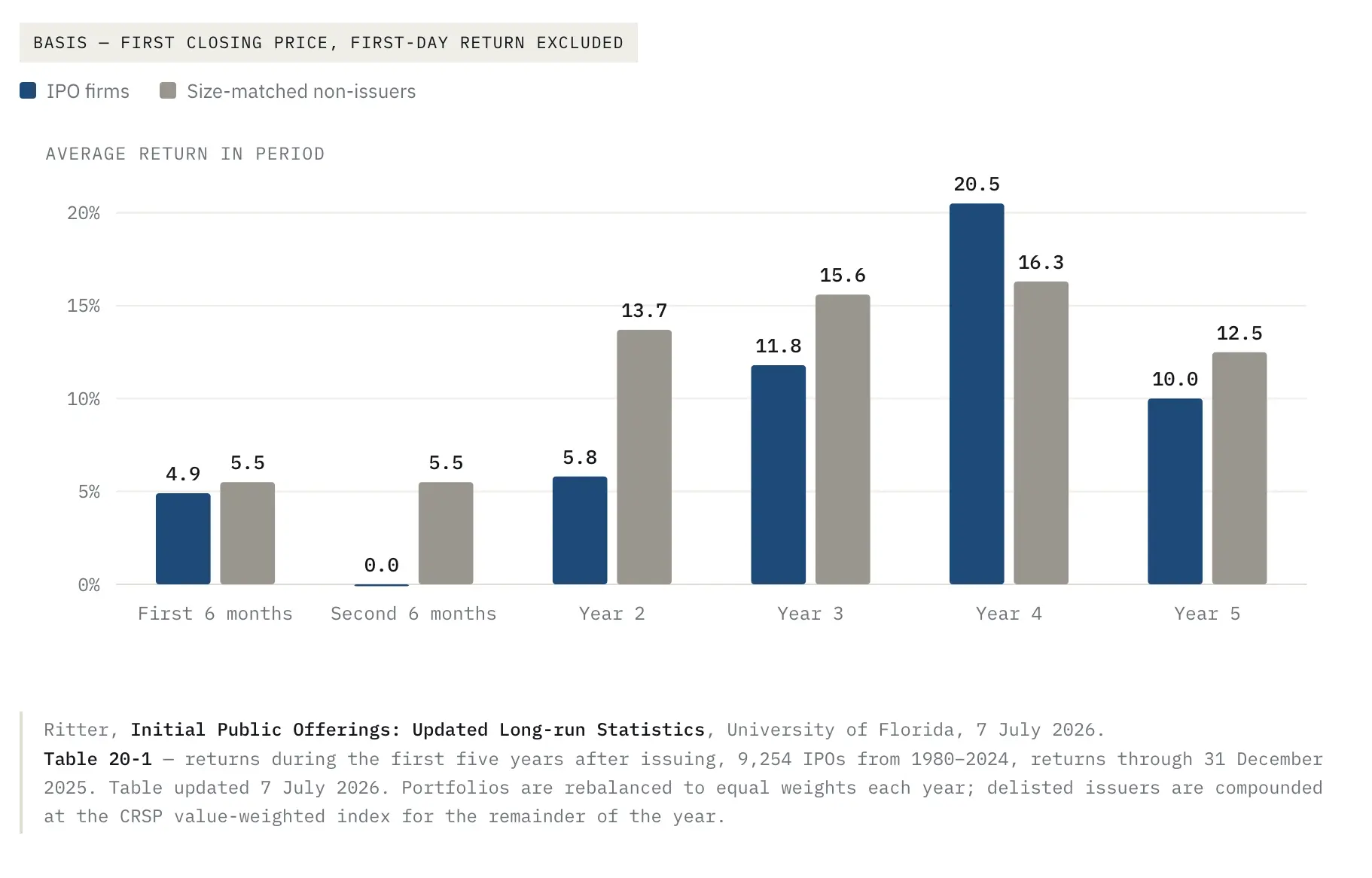
This makes sense too. The management team’s incentive is to get as much money from an IPO as possible. After all, equity, as a source of funding, is a lot more expensive than debt. With debt your cost is the interest. With equity, your cost of capital is a portion of all future earnings of the business. Logically, a company should only want to sell equity, or IPO, when the price they can receive is over and above the intrinsic value of the business.
By avoiding IPOs as a rule, the intelligent investor can save themselves a lot of time, effort, and money. The nuanced take, of course, is that these are averages and some businesses do outperform in the long term. Probably, the correct stance is to be highly skeptical and if the business truly is interesting to you, approach it from the same fundamentals-based perspective that you would for any other business. That might lead you to buying on the opening day, or waiting for the price to come down to something more reasonable.
2. Set A Maximum PE Ratio
Graham recommends setting a personal limit to the size of the price-earnings ratio Mr. Market offers you. In the book he recommends 20-25x. The reasoning behind this is rooted in a fundamental understanding of what the PE ratio actually is: the number of years it would take to get your money back if earnings stayed the same. Since no one reasonably wants to wait 25 years for a return, a PE ratio of 25 implies a strong expectation of future earnings growth.
Remember, you are betting on a future that we don’t know will exist. That’s okay. Betting on the future is, in essence, what investing is. But setting a limit on the PE ratio forces you to act with humility and stops you from making too big of a mistake.
My personal take is that some businesses, or industries, that didn’t exist when Graham wrote the book probably deserve multiples higher than 25. At least on an unadjusted basis. Some people have made strong points in the years since The Intelligent Investor was published, that the earnings of businesses like Amazon or Google, need to be looked at differently than standard physical, non-digital, businesses. That is beyond the scope of this review, but ultimately, whether your limit is 25 on the unadjusted earning or on modern-adjusted earnings, setting a limit protects you from your own blindness.
3. Value Traps Are Common
Many new investors, especially those drawn to the value school of investing, make the mistake of thinking that just because a business has experienced a massive sell-off, that it must be trading at a discount to its intrinsic value. This is not the case. Businesses deteriorate over time. They grow slow, stagnant, comfortable. Then someone comes along and disrupts them. Or maybe the market just crowds out and forces prices down. Or the financial landscape changes and growth capital becomes hard to obtain. There are an infinite number of reasons a business can fail. Failure is the base case for most businesses.
It is therefore not sufficient analysis, and is dangerous, to assume that a significant sell-off, or low multiple, is just a case of Mr. Market offering a discount. You must understand the business, why it has sold off, hypothesize on the mechanisms for why the market is in fear, or doubt, and then judge whether it is right or wrong. Only by understanding the intrinsic value of the business, and perhaps the weighted probabilities of possible outcomes can you be reasonably sure the business is truly undervalued, or just another impaired asset.
4. The Margin of Safety
The margin of safety is Ben Graham’s final truly foundational teaching from The Intelligent Investor. A margin of safety, at its core, means only shaking Mr. Market’s hand at a price you believe is vastly wrong, rather than probably wrong. It is the tool that forces the humility discussed throughout this piece. Things go wrong. Indicators are wrong. We live in what might be called a “complex adaptive system”. Small changes in one part of the system can produce large changes across the whole. The margin of safety, therefore, gives us room to be wrong. It protects us from ourselves, and the chaos of the world. It ensures that if we are wrong, our losses are minimized, and it has the added benefit of increasing our upside when we’re right.
A Note For Analysts:
You can work a margin of safety into your analysis in several ways. Perhaps if the business has pricing power, you can assume prices stay the same over your forecasted period. You can use a higher discount rate than might be determined by academic formulas. Or you can perform the analysis to the most realistic and accurate level you can, and then simply set a buy price at -X% of your intrinsic value (my preferred method). You should not, however, use all methods simultaneously. While being overly optimistic is dangerous, being overly conservative is wasteful of your time and opportunities. It is easy for those attracted to value investing to fall into the trap of conservatism and thus never find an opportunity “worthy” of your capital.
Principle 4: Trust your judgement
That brings us to the final principle of Ben Graham’s masterpiece: you have to trust your own judgement. Assuming you’ve done the due diligence necessary to form a strong opinion, do not let the concerns and illusions of the crowd talk you into or out of an opportunity. The opinion of the market, the masses, and the media has no bearing on whether something is true or false. Just by reading and thinking deeply about a single annual report, you probably know more about a business than the average investor in that stock, let alone those who are not invested at all.
Making money in the market, by definition, requires being contrarian and thinking differently. Yet the crowd can be convincing. A lot of ideas seem more convincing simply because someone says them confidently, or because you read them rather than hear them. I certainly find that I am sometimes biased toward information I read on the internet rather than what someone tells me in real life. I don’t know why, but I have noticed it in my own thinking. This is obviously incredibly dangerous, which is why I suggest completely avoiding places like Reddit and similar platforms, where what you read is heavily biased towards the consensus view. I am beginning to think that in today’s world it is more useful to be ignorant of the consensus than to read it. Do your own work, read or consume well-thought-out analysis, and if you’ve built conviction, act on it. The musings of the market don’t matter in the slightest.
Notes
Accept You Don’t Know The Future And Let That Guide You
The Cost Of Underperformance Is Worse Than Just Losing Money
Set A Maximum Limit On The PE Ratio You Will Accept
Diversification Is The Opposite Of Staying In Your Circle Of Competence
Including Management’s Abilities In Your Valuation Is Double Counting
A Margin Of Safety Is The Most Important Tool For The Protective Investor
Companies Resemble Natural Living Organisms
Investing In A Stock Is Investing In A Business
Mr Market Is An Irrational Partner